Can we predict if dunes or Salt Marsh will develop at Hoylake?
Intertidal Zonation:
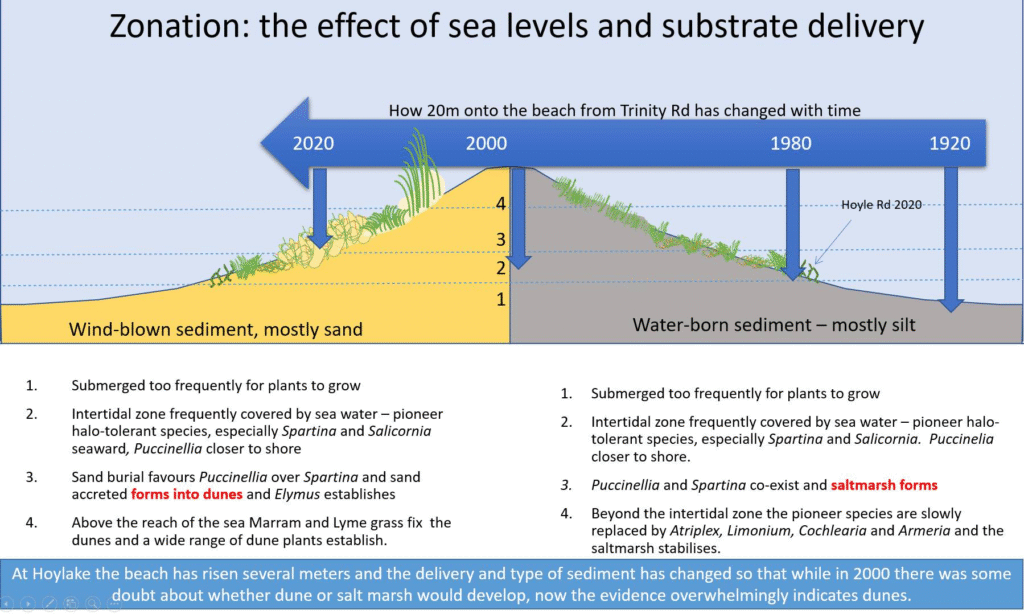
If you have ever looked at a steep rocky shore at low tide, you can see bands of animals and plants at different heights. This is because different organisms are adapted to the gradient of conditions (dominated by time spent in the air and under water). The same processes work on flatter muddy and sandy shores, though the bands are much wider due to the shallow gradients.
Salt marshes:
A salt marsh begins when mud and silt are deposited along a sheltered part of the coastline. This is because rates of deposition are greater than transportation due to the lack of energy in the waves. The deposition builds up over time meaning that the mud breaks the surface to form mudflats. Some plants then begin to grow. The first plants are typically Spartina (Cord Grass) and Salicornia (Samphire), which are tolerant to saltwater. Due to the sediment and material accumulating, it gets covered by the tide for shorter periods. This and rain will leach (wash out) some of the salt. As the salt is now lower in concentration, it means more plants can start to grow. Puccinellia (Salt Marsh Grass) is an early coloniser The ranges of salt marsh plant populations are generally limited in the seaward direction by their ability to withstand marine inundations. In the landward direction, they tend to be limited by competition, particularly shading by other plants.
Dune Systems:
Dunes form when sand is deposited along a coastline faster than wave action can remove it. As with salt marshes, the initial pioneer plants are typically Spartina and Salicornia, with Puccinellia following when the accretion is sufficient to reduce the amount of time spent under seawater. Puccinellia with its preference for being buried in sand, and Elymus (Sand Couch) colonise early, followed by a wide range of dune specialist species, until Marram or Lyme Grass establish above the reach of the sea in all but exceptional conditions, and fix the dunes.
What is the crucial decider in predicting dunes or salt marsh?
It all comes down to the sediment, specifically the rate of sediment delivery and the balance of sediment type delivered. This means that the relative contribution of wind and water delivery of sediment and tidal scour play a role. It is important to remember that the plants are just an indicator of the changes in beach level, not the cause of it, though of course their roots will reduce tidal scour and accelerate the accretion process. Unless the beach level are rising and producing conditions where it is possible for pioneer plants to establish, there can be no vegetation. Both the Sefton coast and the Fylde coast demonstrate the subtleties of the processes. Marshide and Southport are forming saltmarsh, Birkdale and Crosby are forming dunes, while Formby isn’t accreting at all its eroding (and adding to the accretion to either side of it.) On the Fylde coast St Annes is still receiving huge amounts of sand and is still forming dunes, but a few km away, Lytham has virtually no sand delivery and the Ribble is still delivering mud and silt, so it has formed saltmarsh.
So what is going to happen at Hoylake?
The environmental conditions at Hoylake resemble those at Birkdale in terms of sand supply, lack of silt supply, rising beach levels and relative exposure. The plant species establishing include many dune specialists and the entire coast was dunes previously so if the sand keeps blowing in, it’s pretty much certain that there will be impressive dunes at Hoylake again. If you look at the seaward side of the main vegetation band, you can see Puccinellia doing its trick of building hummocks.
References:
For now these are general (the area is so well established I’ve used teaching materials). So far the only primary research isn’t UK/Europe specific.
I will add additional resources as and when I find them
How do salt marshes form?
Is zonation on coastal sand dunes determined primarily by sand burial or by salt spray? A test in New Zealand dunes